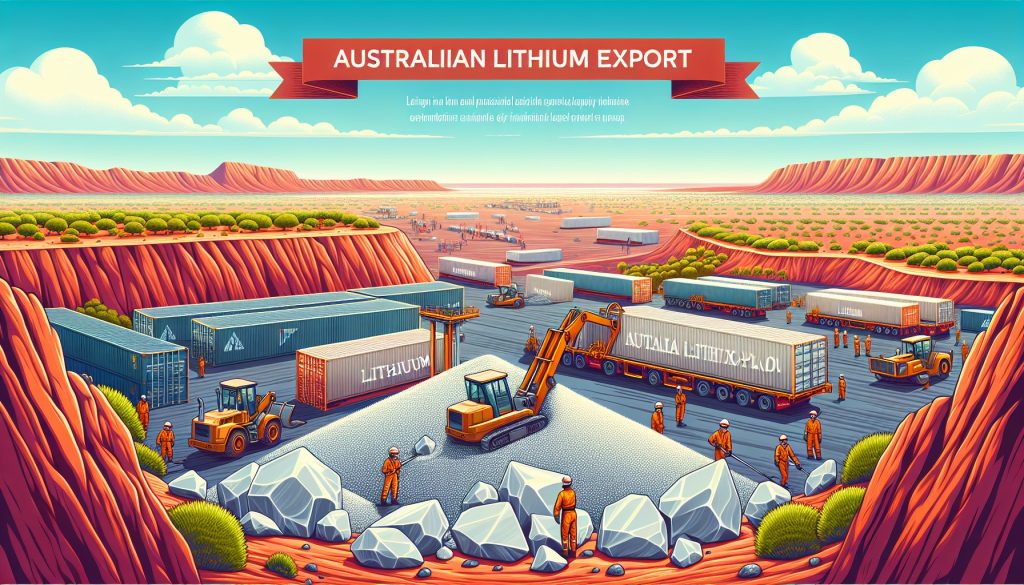
Australia’s dominance in the global lithium market has reached a pivotal moment, with production levels surging to unprecedented heights and fundamentally reshaping investor expectations across the battery supply chain. The nation’s position as the world’s largest lithium producer has strengthened considerably, with Australian lithium export volumes climbing to record-breaking levels that are sending ripples through international markets and capturing the attention of institutional investors worldwide.
The remarkable expansion in Australia’s lithium production capacity stems from a perfect convergence of factors: abundant high-grade spodumene deposits, streamlined mining operations, and an insatiable global appetite for battery-grade lithium compounds. Western Australia’s lithium triangle, encompassing major operations in the Pilbara region, has become the epicenter of this transformation, with established players ramping up extraction rates while new entrants bring additional capacity online at an accelerating pace.
Recent production data reveals that Australian lithium export tonnages have increased by approximately 40% compared to the previous year, driven primarily by expanded operations at flagship sites including Greenbushes, Mount Marion, and Wodgina. This surge has not only solidified Australia’s market leadership but also created significant pricing dynamics that are reverberating throughout the global lithium supply chain. The increased supply has helped stabilize previously volatile lithium carbonate prices, providing much-needed predictability for downstream battery manufacturers and electric vehicle producers.
For investors tracking the lithium sector, these production increases represent both opportunities and challenges. The substantial boost in Australian lithium export volumes has created a more competitive landscape, with traditional premium pricing models giving way to volume-based strategies. Mining companies that have successfully scaled their operations are experiencing robust cash flow generation, while those struggling to achieve operational efficiency face mounting pressure to optimize their extraction and processing capabilities.
The ripple effects of Australia’s lithium production boom extend far beyond mining company balance sheets. Downstream processors, particularly in China, are adjusting their procurement strategies to capitalize on increased Australian supply availability. This shift has led to more favorable long-term contracts for buyers and has encouraged additional investment in lithium hydroxide and carbonate processing facilities designed to handle the specific characteristics of Australian spodumene concentrates.
Infrastructure developments have played a crucial role in supporting the Australian lithium export surge. Port facilities in Fremantle and other Western Australian harbors have expanded their capacity to handle increased lithium concentrate shipments, while rail and trucking networks have been upgraded to accommodate higher volumes. These logistical improvements have reduced transportation bottlenecks that previously constrained export potential, enabling mining companies to fully capitalize on their expanded production capacity.
The investment implications of Australia’s lithium production surge are multifaceted and far-reaching. Established lithium miners with proven reserves and efficient operations have seen their valuations stabilize after years of extreme volatility, attracting renewed institutional interest. Meanwhile, exploration companies with promising Australian lithium assets are experiencing increased acquisition interest from major players seeking to expand their resource base and production capacity.
Environmental and regulatory considerations continue to shape the Australian lithium export landscape, with mining companies increasingly focused on sustainable extraction practices and community engagement. The implementation of more stringent environmental standards has actually benefited well-capitalized operators, as compliance costs create barriers to entry for smaller, less-funded competitors. This regulatory environment has contributed to industry consolidation and improved operational standards across the sector.
Looking at the broader market dynamics, the surge in Australian lithium export volumes comes at a critical time for the global energy transition. Electric vehicle adoption rates continue accelerating worldwide, while grid-scale energy storage deployments are expanding rapidly to support renewable energy integration. This growing demand provides a strong foundation for continued Australian lithium export growth, even as new supply sources in other regions gradually come online.
The transformation of Australia’s lithium industry from a niche mining sector to a cornerstone of the global energy transition represents one of the most significant commodity market developments in recent years. With production volumes reaching record levels and export infrastructure continuing to expand, Australian lithium export capacity is positioned to meet growing international demand while generating substantial returns for investors who recognize the strategic importance of securing reliable access to this critical battery material. The confluence of operational excellence, resource abundance, and favorable market conditions has created an investment environment where Australian lithium producers are not merely participating in the energy transition but actively driving its acceleration through unprecedented supply capabilities.