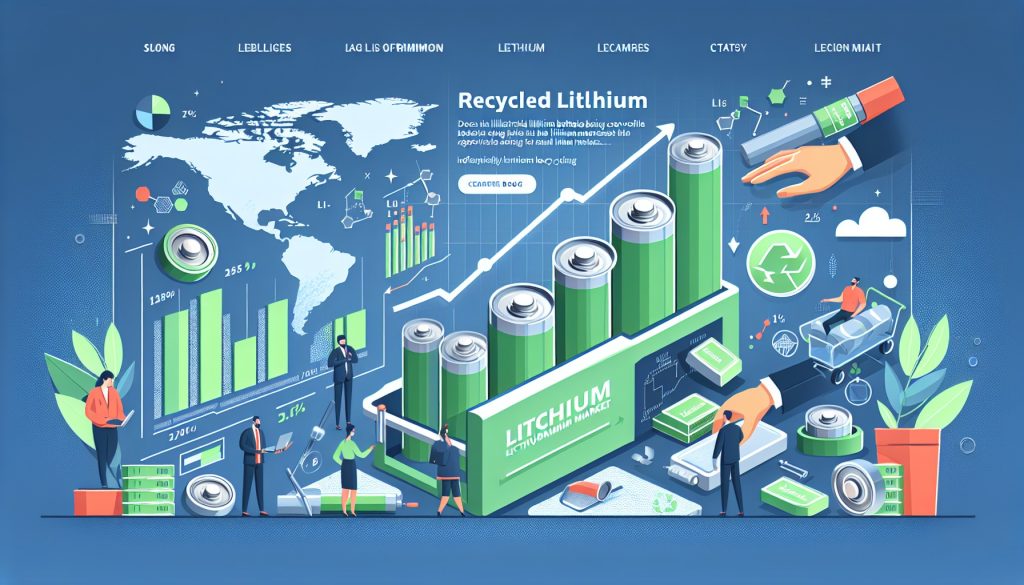
The electric vehicle revolution has reached a critical juncture where sustainability meets scalability, and at the heart of this transformation lies an increasingly vital sector: the recycled lithium market. As EV adoption accelerates globally, manufacturers are discovering that the answer to lithium supply constraints isn’t just mining more ore—it’s creating a circular economy that transforms used batteries into valuable resources.
Traditional lithium extraction from brine pools and hard rock mining faces mounting challenges, from environmental concerns to geopolitical supply chain risks. The recycled lithium market has emerged as a strategic solution, offering manufacturers a more predictable and environmentally responsible source of this critical battery component. Recent industry analysis reveals that recycled lithium now costs approximately 30% less than newly mined lithium while reducing carbon emissions by up to 75% during the production process.
Major automotive manufacturers have recognized this opportunity, with Tesla, General Motors, and Volkswagen investing heavily in closed-loop recycling partnerships. These collaborations with specialized recycling companies create a seamless flow where end-of-life EV batteries are processed into battery-grade lithium carbonate and lithium hydroxide. The recycled lithium market has responded by scaling operations dramatically, with processing capacity increasing by over 400% in the past three years alone.
The technology behind lithium recycling has evolved significantly, moving beyond simple recovery methods to sophisticated processes that achieve 95% purity rates. Hydrometallurgical and pyrometallurgical techniques now extract not just lithium, but also cobalt, nickel, and manganese from spent batteries. This comprehensive approach makes the recycled lithium market economically attractive while addressing multiple supply chain vulnerabilities simultaneously.
Market dynamics favor recycling companies positioned to handle the growing volume of first-generation EV batteries reaching end-of-life status. Industry projections indicate that by 2030, recycled lithium could supply up to 20% of total lithium demand for new EV batteries. This shift represents a fundamental change in how manufacturers approach resource procurement, moving from linear consumption models to circular systems that continuously reuse materials.
Geographic considerations also play a crucial role in the recycled lithium market’s expansion. Countries with established EV markets, including the United States, Germany, and China, are developing regional recycling hubs that reduce transportation costs and improve supply chain resilience. These facilities not only process domestic battery waste but also import spent batteries from neighboring regions, creating efficient recycling ecosystems.
Quality standards in the recycled lithium market have reached parity with mined lithium, eliminating previous concerns about performance degradation. Advanced purification processes ensure that recycled lithium meets or exceeds specifications for next-generation battery chemistries, including solid-state batteries and high-nickel cathode formulations. This quality assurance has accelerated adoption among premium EV manufacturers who previously relied exclusively on virgin materials.
The recycled lithium market represents more than an environmental initiative—it’s become a competitive advantage for manufacturers seeking cost stability and supply security. As the EV revolution continues expanding globally, companies that establish strong positions in lithium recycling will likely maintain significant advantages in manufacturing costs, regulatory compliance, and consumer appeal. The circular economy model isn’t just powering individual vehicles; it’s driving the entire industry toward a more sustainable and economically viable future.
