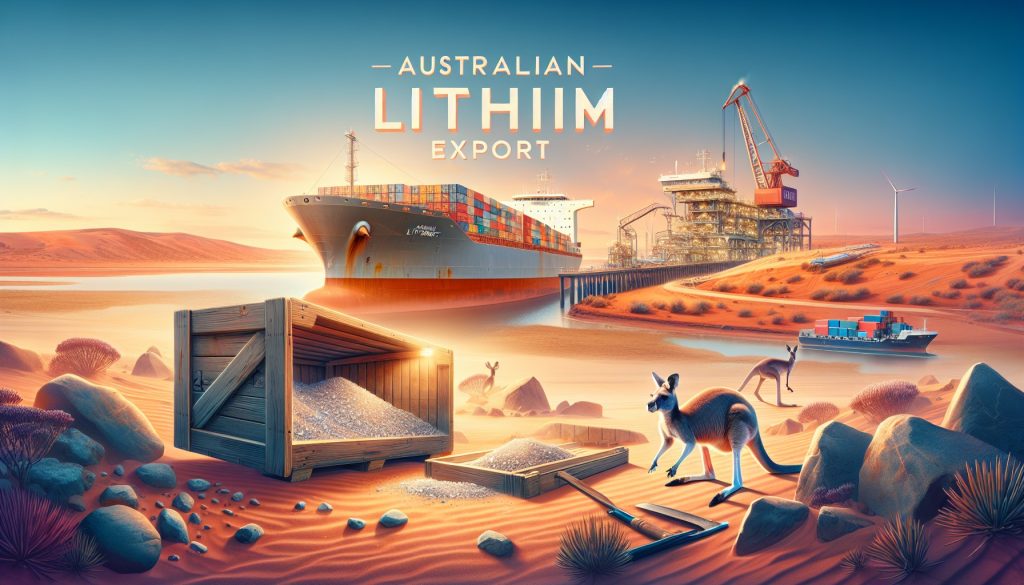
Australia’s dominance in the global lithium market has reached unprecedented heights, with export volumes surging to record levels as electric vehicle demand rebounds and battery manufacturers rebuild their supply chains. The Australian lithium export industry, which accounts for approximately 60% of global lithium production, is navigating a complex landscape of recovering prices, evolving international relationships, and massive infrastructure investments that are reshaping the critical minerals sector.
Recent data from the Australian Bureau of Statistics reveals that lithium exports have not only recovered from previous volatility but have established new benchmarks for both volume and strategic importance. Major mining operations across Western Australia’s lithium triangle continue to expand capacity, while new players enter the market with innovative processing technologies that promise to enhance Australia’s position in the global supply chain.
Export Volume Surge Drives Market Optimism
Australian lithium export figures have demonstrated remarkable resilience, with shipments increasing by over 35% compared to the previous year’s levels. The Pilbara region, home to some of the world’s largest lithium deposits, has become the epicenter of this expansion. Major operations including Greenbushes, Mount Marion, and Wodgina have ramped up production significantly, contributing to Australia’s ability to meet growing international demand.
Industry analysts point to several factors driving this surge. Electric vehicle sales in key markets including China, Europe, and North America have rebounded strongly, creating sustained demand for lithium-ion batteries. Additionally, energy storage projects worldwide have accelerated deployment, requiring substantial lithium supplies. The Australian lithium export sector has proven particularly adept at scaling operations quickly to meet this demand, leveraging established mining expertise and robust infrastructure networks.
China remains the dominant destination for Australian lithium exports, accounting for approximately 85% of shipments. However, diversification efforts are showing progress, with increased exports to South Korea, Japan, and emerging processing facilities in North America and Europe. This geographic diversification reflects both market demand patterns and strategic considerations around supply chain security.
Price Recovery Transforms Industry Dynamics
The lithium market has experienced significant price volatility over recent years, but current trends indicate a stabilization that benefits Australian exporters. Lithium carbonate equivalent prices have recovered substantially from previous lows, currently trading in ranges that support profitable operations across most Australian lithium export facilities.
This price recovery has triggered a wave of expansion projects and new developments. Companies are investing heavily in both mining capacity and downstream processing capabilities. Several major Australian lithium producers have announced plans to develop local processing facilities, potentially transforming the country from primarily a raw material exporter to a more integrated supplier of battery-grade lithium compounds.
The pricing environment has also influenced global supply chain decisions. Battery manufacturers and automotive companies are increasingly willing to secure long-term supply agreements with Australian producers, providing the revenue certainty needed to support major capital investments. These offtake agreements often span multiple years and include pricing mechanisms that benefit both parties while ensuring supply security.
Infrastructure Investments Accelerate Growth
Supporting the expansion of Australian lithium export capacity requires substantial infrastructure development, and both government and private sector investments are flowing into critical projects. Port facilities in Western Australia are undergoing major expansions to handle increased lithium shipments, while rail networks are being upgraded to improve transport efficiency from mine sites to export terminals.
Perhaps most significantly, the development of domestic processing capabilities represents a fundamental shift in Australia’s lithium industry strategy. New lithium hydroxide and carbonate processing plants are under construction, designed to capture more value from the country’s abundant spodumene resources. These facilities will enable Australian companies to supply battery manufacturers directly with processed materials rather than shipping raw ore for processing overseas.
The Australian government has also announced supportive policies including infrastructure grants, research and development incentives, and streamlined approval processes for critical minerals projects. These initiatives recognize lithium’s strategic importance and aim to maintain Australia’s competitive advantages in the global market.
Global Competition and Strategic Positioning
While Australia maintains its leadership position in lithium production, international competition is intensifying. New lithium projects in Argentina, Chile, and other jurisdictions are advancing toward production, potentially increasing global supply in coming years. Additionally, alternative lithium sources including brine operations and even lithium recycling are scaling up, creating a more diverse global supply landscape.
Australian lithium export companies are responding to this competition through operational excellence, technological innovation, and strategic partnerships. Many producers are investing in automation and digital technologies to reduce costs and improve efficiency. Others are forming joint ventures with international partners to access new markets and share development risks.
Environmental, social, and governance considerations are also becoming increasingly important in lithium supply chain decisions. Australian producers generally benefit from the country’s strong regulatory environment and established mining practices, providing advantages when competing for contracts with ESG-conscious customers.
The trajectory of Australian lithium export markets reflects broader transformations in the global energy system and transportation sector. As battery demand continues expanding across multiple applications, Australia’s abundant resources, established infrastructure, and mining expertise position the country to remain a dominant force in lithium supply chains. However, success will depend on continued investment in processing capabilities, infrastructure development, and maintaining competitive cost structures in an increasingly dynamic global market. The industry’s ability to adapt to changing customer requirements while scaling production sustainably will ultimately determine Australia’s long-term position in the critical minerals landscape.