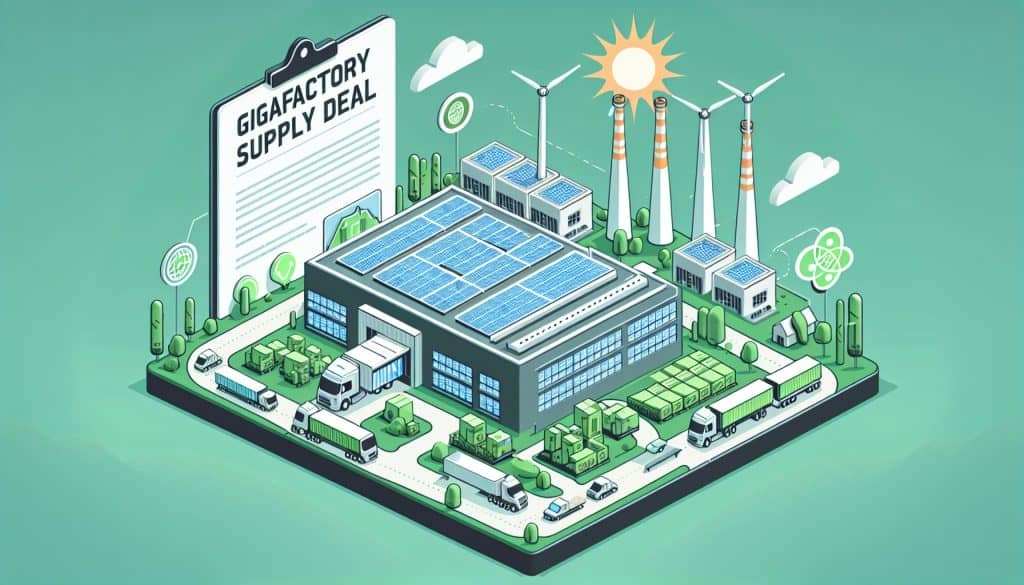
The landscape of renewable energy manufacturing is experiencing a seismic shift as major battery producers lock in long-term supply agreements that promise to reshape both the lithium market and green energy investment opportunities. These strategic partnerships are not just business transactions—they represent a fundamental realignment of global supply chains toward sustainable energy infrastructure.
The recent wave of gigafactory supply deal announcements has caught the attention of institutional investors and analysts worldwide. Tesla’s Nevada facility, Panasonic’s Kansas operations, and Ford’s Michigan complex are all securing multi-billion dollar agreements with lithium suppliers, signaling unprecedented confidence in electric vehicle adoption rates. These deals typically span 5-10 years and guarantee supply volumes that dwarf historical precedents, with some agreements covering over 100,000 tons of lithium carbonate equivalent annually.
What makes these agreements particularly significant is their pricing structure and geographic diversification. Unlike previous spot-market purchases that exposed manufacturers to volatile commodity pricing, the current generation of gigafactory supply deal contracts incorporates sophisticated hedging mechanisms and floor-price guarantees. This stability allows battery manufacturers to offer more competitive pricing to automakers while providing lithium producers with predictable revenue streams that justify massive capital expenditures on new extraction and processing facilities.
The ripple effects extend far beyond the immediate parties involved. Australian lithium miners like Pilbara Minerals and Chilean producers such as SQM are experiencing unprecedented demand for their output, with many reporting fully booked production capacity through the end of the decade. This supply constraint has prompted innovative financing arrangements where gigafactory operators provide upfront capital to mining companies in exchange for guaranteed allocation percentages—a model that’s becoming the industry standard.
Investment Implications Across the Value Chain
Smart money is following these supply agreements upstream and downstream, recognizing that each gigafactory supply deal creates investment opportunities across multiple sectors. Lithium processing facilities, rare earth element suppliers, and specialized transportation companies are all benefiting from the increased predictability these long-term contracts provide. The infrastructure required to support gigafactory operations—from specialized rail lines to processing plants—represents billions in additional capital deployment.
Environmental considerations are increasingly driving the structure of these agreements. Many recent gigafactory supply deal negotiations include specific sustainability requirements, with battery manufacturers demanding proof of reduced carbon footprints in lithium extraction and processing. This has accelerated investment in direct lithium extraction technologies and renewable energy-powered processing facilities, creating new subsectors within the broader green energy investment landscape.
The geopolitical dimension cannot be ignored. As nations recognize the strategic importance of battery supply chains, government incentives and policy support are amplifying the financial returns available to investors in this space. The U.S. Inflation Reduction Act’s domestic content requirements have made North American lithium projects particularly attractive, with some receiving additional tax credits that improve project economics by 15-20%.
Market Dynamics and Future Outlook
Current market analysis suggests that existing gigafactory supply deal commitments cover only 60-70% of projected lithium demand through 2030, indicating significant opportunity for additional agreements and investment. The gap between supply commitments and projected demand has created a premium market for uncommitted lithium resources, with some projects trading at valuations that reflect scarcity premiums of 40-50% above traditional asset pricing models.
Technology evolution continues to influence deal structures. Next-generation battery chemistries requiring different lithium compounds are prompting more flexible supply agreements that can accommodate shifting technical specifications. This adaptability premium is reflected in higher valuations for diversified lithium producers capable of delivering multiple product grades.
The convergence of technological advancement, policy support, and strategic supply planning has created an investment environment where gigafactory supply deal announcements serve as reliable indicators of sector health and growth trajectory. For investors seeking exposure to the green energy transition, these agreements provide transparent visibility into demand patterns, pricing trends, and capital allocation priorities across the entire battery value chain. The current wave of deal-making represents not just supply chain optimization, but the foundation of a transformed global energy infrastructure that promises sustained investment returns for those positioned correctly within this evolving ecosystem.
