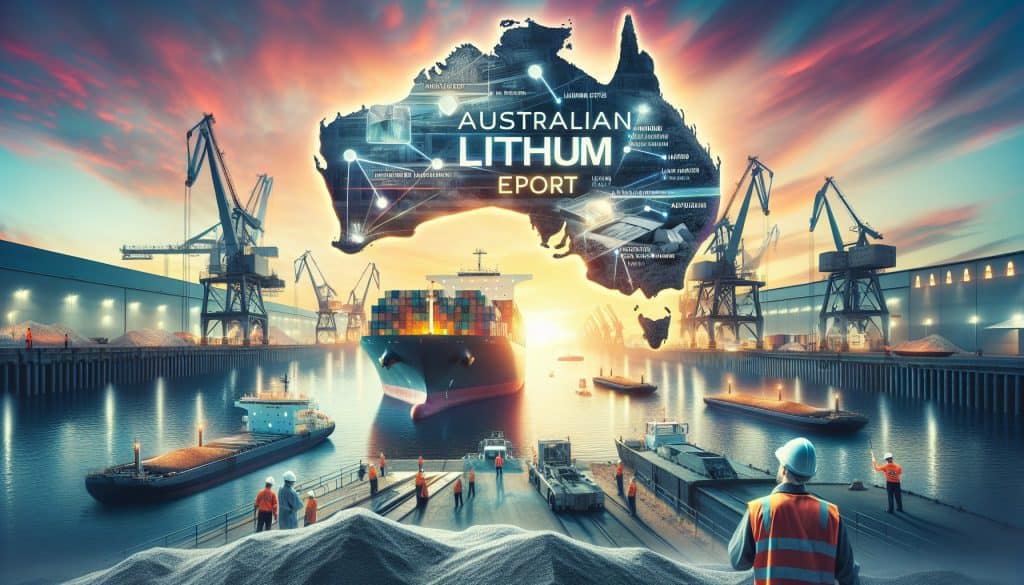
Smart money is flowing toward one of the most compelling investment narratives in the commodities sector today. As electric vehicle adoption accelerates worldwide and renewable energy storage demands surge, investors are increasingly focused on the nations that control critical battery materials. At the center of this strategic shift lies Australia’s remarkable lithium sector, where export operations are reshaping global supply chains and creating substantial opportunities for informed investors.
The Australian lithium export industry has undergone a dramatic transformation over the past several years, evolving from a niche mining operation into a cornerstone of the global battery supply chain. Australia now accounts for approximately 55% of the world’s lithium production, with its high-grade spodumene concentrates serving as the primary feedstock for lithium processing facilities across Asia. This dominant position has been built on the foundation of world-class deposits in Western Australia’s Pilbara region, where companies like Pilbara Minerals, Mineral Resources, and Core Lithium are scaling operations to meet unprecedented demand.
What sets Australian lithium export operations apart is not just the scale of production, but the quality and consistency of the product. Australian spodumene typically contains lithium oxide concentrations of 5.5% to 6.5%, significantly higher than many competing sources. This premium quality translates directly into higher prices and stronger margins for Australian producers, creating a sustainable competitive advantage that has caught the attention of institutional investors worldwide.
The geopolitical landscape surrounding battery materials has further elevated the importance of Australian lithium export capabilities. As nations seek to diversify their supply chains away from single-country dependencies, Australia’s stable political environment, established mining infrastructure, and strong rule of law make it an increasingly attractive partner. Major battery manufacturers and automotive companies are now signing long-term offtake agreements directly with Australian producers, providing revenue certainty and validating the long-term demand outlook.
Recent market dynamics have demonstrated the resilience of the Australian lithium export sector even amid commodity price volatility. While lithium prices experienced significant fluctuations through various market cycles, Australian producers have consistently maintained their market share and operational efficiency. This stability stems from their low-cost production profiles and established relationships with downstream processors, particularly in China, Japan, and South Korea.
The infrastructure supporting Australian lithium export operations continues to expand and modernize. Port facilities in Fremantle and Esperance have been upgraded to handle increased lithium concentrate shipments, while rail and road networks connecting mine sites to ports have seen substantial investment. These infrastructure improvements reduce transportation costs and increase the reliability of supply chains, further strengthening Australia’s competitive position.
Investment flows into Australian lithium export projects have reached record levels, with both domestic and international capital supporting expansion plans. Major mining companies are committing billions of dollars to develop new mines and expand existing operations. This capital deployment is creating a multiplier effect throughout the Australian economy, generating employment in regional areas and supporting service industries that cater to the mining sector.
The technological advancement within Australian lithium export operations is also noteworthy. Companies are implementing advanced processing techniques, automated mining equipment, and sophisticated logistics systems to optimize their operations. These technological improvements are increasing recovery rates, reducing operating costs, and minimizing environmental impacts, creating more sustainable and profitable operations.
Market analysts project that Australian lithium export volumes will continue growing substantially over the next decade. With global lithium demand expected to increase by more than 400% by 2030, driven primarily by electric vehicle adoption and energy storage requirements, Australia’s production capacity expansion plans appear well-positioned to capture this growth. Several new projects are scheduled to commence production in the coming years, potentially doubling Australia’s current export capacity.
For investors seeking exposure to the energy transition mega-trend, Australian lithium export represents one of the most direct and compelling opportunities available. The combination of resource quality, operational expertise, geopolitical stability, and growing global demand creates a investment thesis that extends well beyond typical commodity cycles. As the world continues its shift toward electrification and renewable energy, the companies and nations that control critical battery materials will likely see their strategic importance and financial returns grow accordingly.
