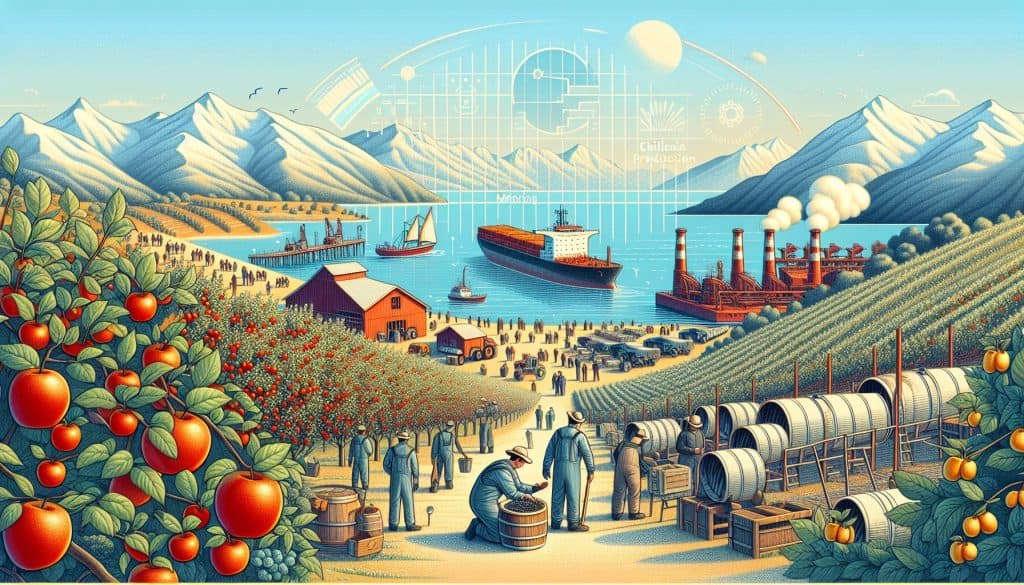
Chile’s industrial landscape is experiencing a remarkable transformation that has captured the attention of global investors and economists alike. The South American nation, long recognized for its copper mining dominance, is now demonstrating impressive diversification across multiple production sectors, with Chilean production output reaching levels that signal a fundamental shift in the country’s economic trajectory.
The mining sector continues to serve as Chile’s industrial backbone, with copper production maintaining its position as a global benchmark. Recent data indicates that Chilean mines are operating at enhanced efficiency levels, driven by technological upgrades and improved extraction methodologies. Beyond copper, lithium production has emerged as a strategic growth driver, positioning Chile at the forefront of the electric vehicle battery supply chain. The country’s vast lithium reserves in the Atacama Desert are now being developed with increased sophistication, contributing significantly to overall Chilean production output figures.
Manufacturing capabilities have undergone substantial expansion, particularly in food processing, textiles, and chemical production. Chilean wineries have modernized their operations, implementing advanced fermentation technologies and sustainable production practices that have elevated both quality and volume. The food processing industry has benefited from Chile’s abundant agricultural resources, with fruit processing and seafood packaging facilities operating at record capacity levels. These developments represent a notable diversification away from pure commodity dependence.
Infrastructure investments have played a crucial role in supporting increased production capacity across all sectors. The government has prioritized port facility upgrades, road network enhancements, and energy grid modernization to accommodate growing industrial demands. Chile’s commitment to renewable energy has proven particularly beneficial, with solar and wind power installations providing cost-effective electricity to energy-intensive industries. This sustainable approach to industrial power has attracted international manufacturers seeking environmentally responsible production bases.
International trade partnerships have created new opportunities for Chilean producers to access global markets more effectively. Recent trade agreements have reduced barriers for Chilean exports, enabling manufacturers to compete more aggressively in North American, European, and Asian markets. The country’s strategic Pacific coast location provides advantageous shipping access to major Asian economies, while established relationships with European partners ensure continued Atlantic trade growth.
Investment implications extend beyond traditional commodity exposure, as Chilean production output diversification creates opportunities across multiple sectors. Manufacturing growth offers exposure to consumer goods and industrial equipment markets, while agricultural processing provides access to global food security themes. The lithium sector presents compelling opportunities related to global electrification trends, positioning Chile as an essential supplier for future technology development.
Labor market developments have supported production growth through skills development programs and workforce expansion initiatives. Technical education programs have aligned with industry needs, producing qualified workers for mining operations, manufacturing facilities, and logistics operations. Wage growth has remained moderate, maintaining Chile’s competitive position while supporting domestic consumption that further stimulates local production demand.
Technology adoption across Chilean industries has accelerated significantly, with automation and digital monitoring systems improving efficiency and reducing operational costs. Mining operations now utilize advanced sensor networks and predictive maintenance systems that maximize equipment uptime and optimize extraction processes. Manufacturing facilities have implemented lean production methodologies and quality control systems that meet international standards, enabling Chilean products to compete effectively in premium market segments.
Financial markets have responded positively to Chile’s production achievements, with equity valuations reflecting improved earnings potential across multiple industries. Currency stability has supported international investment flows, while reasonable debt levels provide fiscal flexibility for continued infrastructure and industrial development. Credit ratings reflect the country’s improved economic diversification and reduced commodity dependence, creating favorable borrowing conditions for continued expansion.
The trajectory of Chilean production output suggests sustained growth potential that extends well beyond traditional economic cycles. With strong institutional frameworks, continued infrastructure investment, and strategic positioning in global supply chains, Chile presents compelling opportunities for investors seeking exposure to Latin American industrial growth. The combination of resource advantages, technological advancement, and market access positions Chilean production capabilities for continued expansion that should benefit both domestic and international stakeholders in the years ahead.