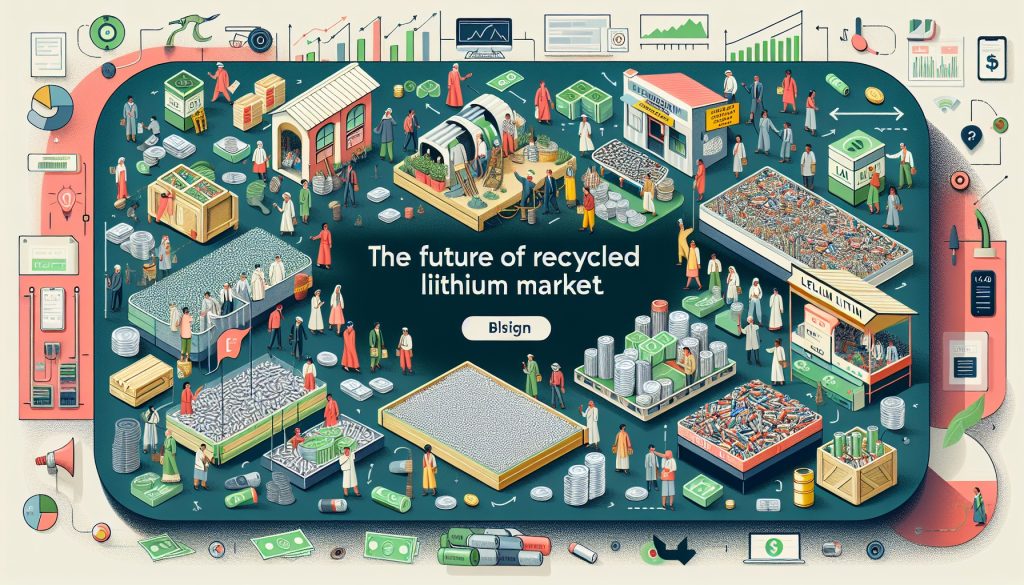
The energy landscape is witnessing a remarkable transformation, and at its heart lies an industry segment that’s capturing the attention of investors, policymakers, and environmental advocates alike. The recycled lithium market has emerged from relative obscurity to become a cornerstone of sustainable energy infrastructure, driven by unprecedented demand for battery materials and growing concerns about resource scarcity.
Traditional lithium extraction has long faced criticism for its environmental impact and geographical limitations. Mining operations in South America’s lithium triangle and hard rock deposits in Australia require significant water resources and can disrupt local ecosystems. As electric vehicle adoption accelerates and grid-scale energy storage projects multiply, the pressure on primary lithium sources has intensified dramatically. This perfect storm of supply constraints and environmental consciousness has created an ideal environment for the recycled lithium market to flourish.
Recent technological breakthroughs have revolutionized lithium recovery from spent batteries. Advanced hydrometallurgical processes now achieve recovery rates exceeding 95%, while new direct recycling methods preserve the crystal structure of cathode materials, delivering even higher value outcomes. Companies like Redwood Materials and Li-Cycle have demonstrated that recycled lithium can match or exceed the quality of mined lithium while reducing production costs by up to 30%. These innovations have transformed what was once considered waste into a premium raw material.
The economics driving the recycled lithium market are compelling. With lithium carbonate prices experiencing significant volatility due to supply chain disruptions and geopolitical tensions, recycled alternatives offer price stability and security of supply that manufacturers desperately need. Major battery producers including CATL, BYD, and Tesla’s supplier network have signed long-term agreements with recycling companies, providing the revenue visibility needed for large-scale facility investments.
Regulatory momentum is accelerating market growth across multiple jurisdictions. The European Union’s Battery Regulation mandates that batteries contain specific percentages of recycled content, creating guaranteed demand for recycled lithium. Similar legislation in California and proposed federal rules in the United States are establishing recycled content requirements that will drive market expansion. These regulatory frameworks provide the policy certainty that has attracted billions in private investment to recycling infrastructure.
Geographic diversification represents another crucial advantage of the recycled lithium market. Unlike primary lithium production concentrated in a handful of countries, recycling facilities can be located near battery manufacturing hubs and end-of-life vehicle processing centers. This distributed model reduces transportation costs, minimizes supply chain risks, and creates regional circular economy clusters that benefit local communities through job creation and reduced waste streams.
Investment capital is flowing into the sector at unprecedented levels. Venture capital firms and strategic investors have deployed over $2.5 billion into lithium recycling companies, funding the construction of commercial-scale facilities across North America, Europe, and Asia. The combination of proven technology, supportive regulations, and strong customer demand has created an investment environment reminiscent of the early solar industry boom.
Environmental benefits extend far beyond reduced mining impact. Recycled lithium production generates approximately 75% fewer carbon emissions compared to traditional extraction and processing. As companies face increasing pressure to demonstrate environmental stewardship and achieve net-zero commitments, recycled lithium provides a tangible way to reduce scope 3 emissions throughout their supply chains. This environmental advantage is becoming increasingly valuable as carbon pricing mechanisms expand globally.
The recycled lithium market is also benefiting from the natural maturation of lithium-ion battery applications. The first generation of electric vehicles is beginning to reach end-of-life, creating a growing feedstock supply for recycling operations. Industry analysts project that by 2030, recycled lithium could supply up to 25% of total market demand, fundamentally reshaping the competitive landscape and reducing dependence on primary extraction.
Quality improvements in recycled materials are addressing previous industry concerns about performance and consistency. Advanced purification techniques now produce battery-grade lithium hydroxide and carbonate that meets the strictest specifications of premium battery manufacturers. Some recycled products actually demonstrate superior performance characteristics due to reduced impurity levels achieved through modern processing technologies.
As the clean energy transition accelerates and circular economy principles gain mainstream adoption, the recycled lithium market stands at the intersection of multiple powerful trends. Its combination of economic viability, environmental benefits, supply security, and technological innovation positions it as a critical enabler of sustainable electrification. For an industry focused on building a cleaner future, recycled lithium represents both a practical solution to immediate challenges and a blueprint for responsible resource management that other sectors are beginning to emulate.
